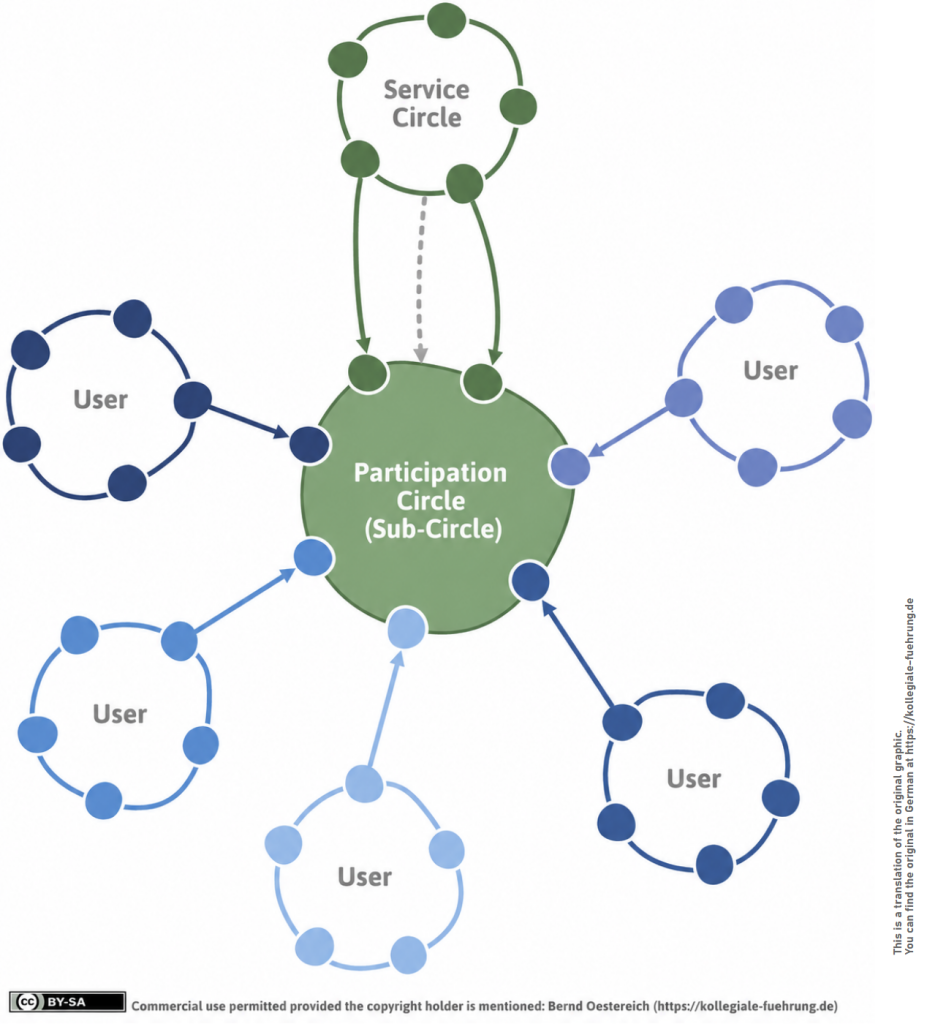
The Participation Circle model describes how internal customers are systematically involved in the design of support services. The Participation Circle links central service circles with the peripheral business circles that utilise their services. Representatives of the user circles participate directly within the service circle or in a separate sub-circle – either in full or through selected representatives.
The aim is to consistently align services with the actual needs of the value-adding units. This puts the principle of ‘serving from the inside out’ into practice. This model is particularly useful in complex support areas such as IT, HR or research, where continuous feedback from users is crucial. It fosters mutual understanding, improves service quality and can reduce tensions between the centre and the periphery.
However, not every interface requires its own participation circle. For simple, standard services, contact persons or informal coordination are often sufficient. In line with the principle of ‘as few circles as possible, as many as necessary’, a participation circle should only be established if the additional coordination effort creates genuine added value.
Source: See here