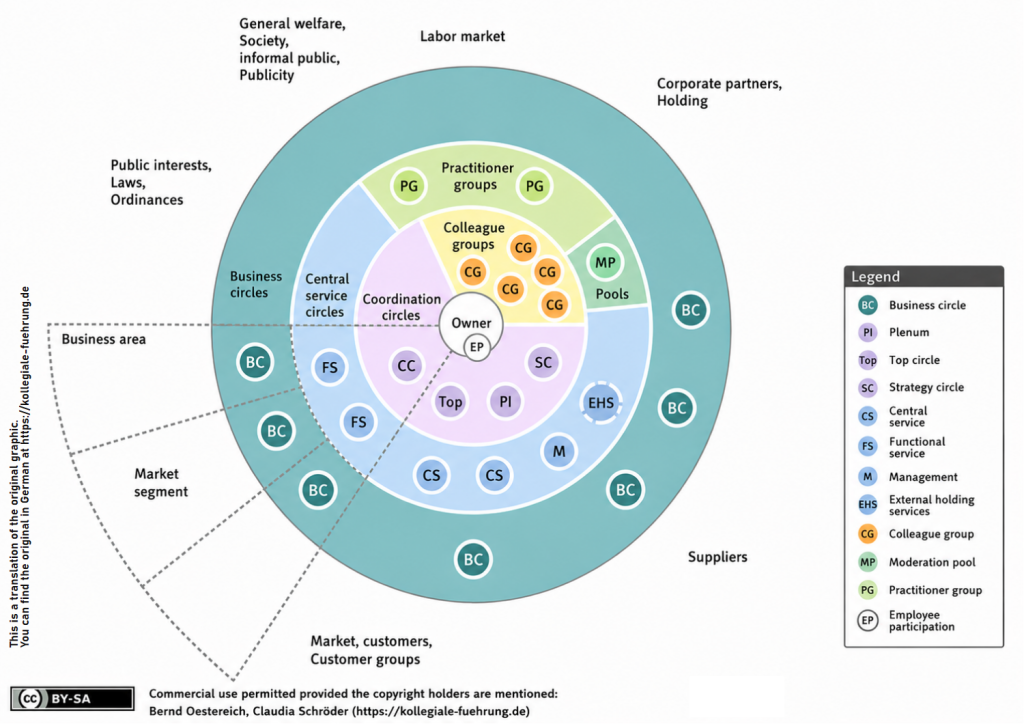
The Circle Model organises the organisation into concentric circles – from the market on the periphery to ownership at the centre. Each type of circle fulfils a clearly defined role.
Business Circles form the outer ring. They generate direct value, maintain close contact with customers and respond immediately to market changes.
Central Service Circles support the Business Circles with services such as IT, HR, marketing and accounting, enabling them to focus on their core business.
Coordination Circles take on organisation-wide tasks such as strategy, brand development and cross-functional coordination.
The Top Circle and the owner form the centre. They establish the organisational framework for self-organisation, define its boundaries and appoint the Shared Leadership.
The circles operate independently and are linked via elected representatives who ensure the flow of information between them. Issues affecting several circles are decided jointly – usually within the Coordination Circle or the Top Circle.
Source: See here