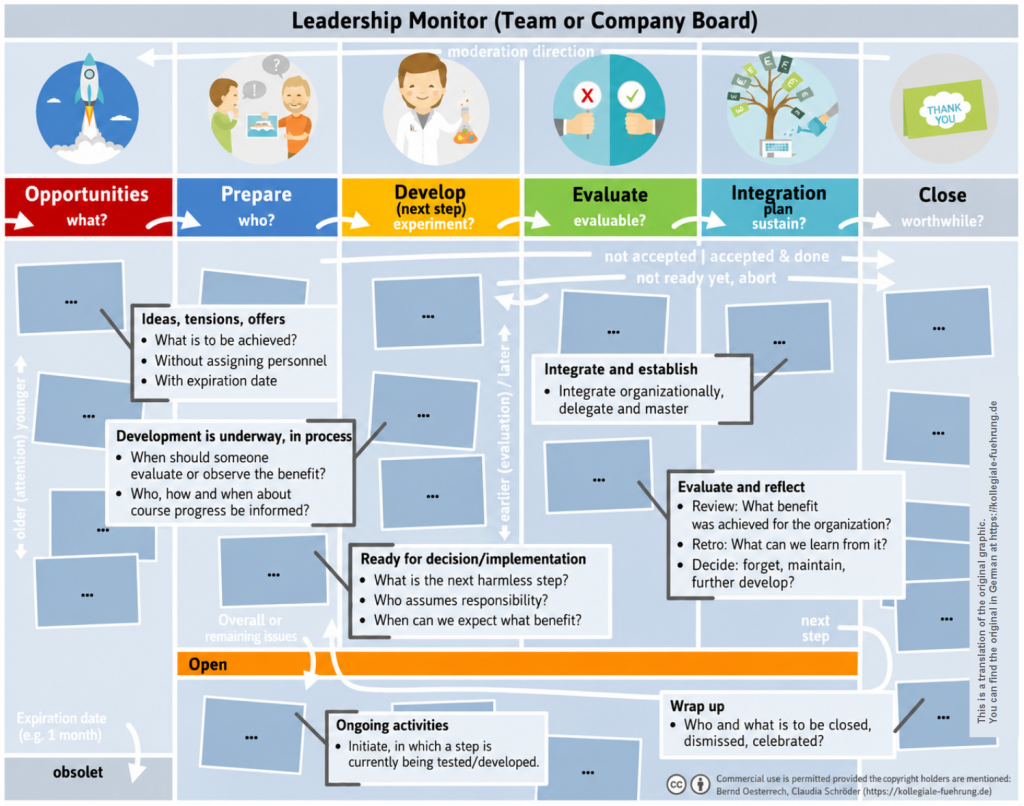
The ‘Lead Monitor’ diagram illustrates a key tool for addressing leadership and organisational issues. Rather than assigning tasks, the Lead Monitor highlights which ideas, tensions or changes should be addressed next. Issues go through several phases: opportunities give rise to specific next steps, which are developed, then evaluated and – if successful – taken forward. This is based on the pull principle: tasks are not assigned, but are taken on by members as soon as capacity becomes available.
The Lead Monitor is used at all levels of the organisation – from the individual circle right up to the top circle. However, it is used exclusively for work on the system, i.e. the further development of structures, processes and leadership issues. Operational routines and day-to-day tasks are deliberately excluded from this board. The ‘Open’ section serves as a holding area for larger projects. Complex topics are broken down into small, manageable steps, so that only the next step is actively worked on at any one time. This ensures that progress and transparency are maintained.
For day-to-day operational business, circles instead use traditional planning boards, for example based on the Kanban principle. These visualise ongoing tasks and are coordinated in short daily or weekly meetings. The separation of these two tools is a deliberate choice: the operational board organises work within the system, whilst the Lead Monitor supports work on the system. In this way, self-managed organisations prevent urgent day-to-day tasks from taking precedence over long-term development.
Source: See here