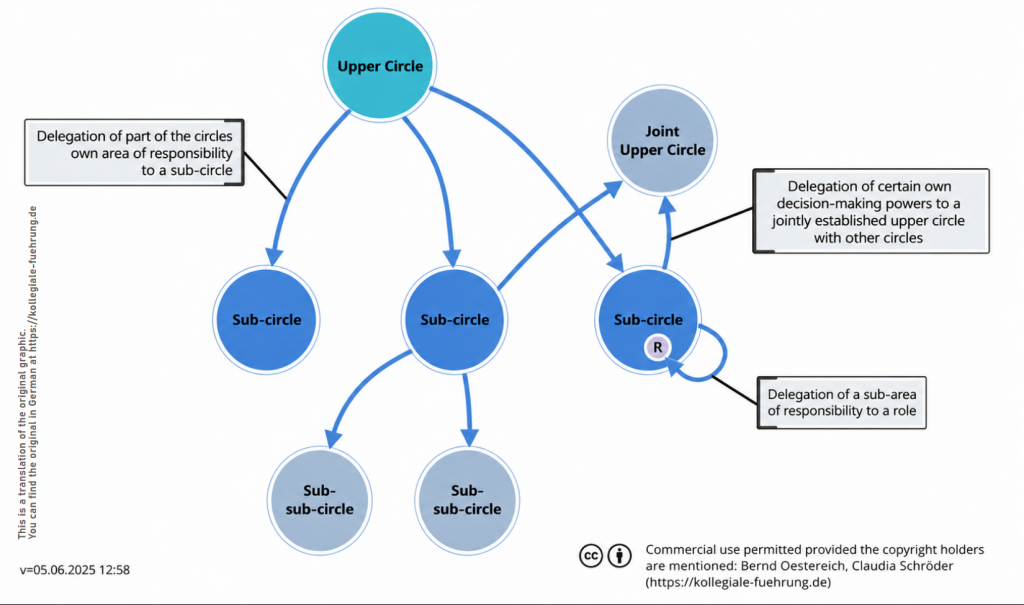
The delegation model within the Circle Constitution describes three fundamental ways in which a circle distributes responsibility and organises itself.
A) Delegation to a role #
The most common form is the distribution of tasks within the circle itself. Individual roles take on clearly defined areas of responsibility where these can be meaningfully carried out by a single person.
B) Delegation to a sub-circle #
If an area of responsibility becomes too complex or extensive, the circle may form a sub-circle and permanently transfer part of its responsibility to it. The sub-circle operates in a self-organised manner within its remit, whilst the parent circle remains responsible for its existence and purpose.
C) Delegation to a joint parent circle #
If several circles wish to make joint decisions on specific issues, they may transfer responsibility to a higher-level coordinating circle – for example, for strategy, investments or shared resources. The decisions made by this circle are binding on the participating circles.
Common to all forms is this: delegation does not mean relinquishing responsibility, but rather a deliberate distribution of decision-making powers. The connection between the levels is maintained through representatives and clearly defined roles. The specific structure can be developed flexibly, provided it remains within the framework set by the owner and responsibility remains clearly assigned.
Source: See here