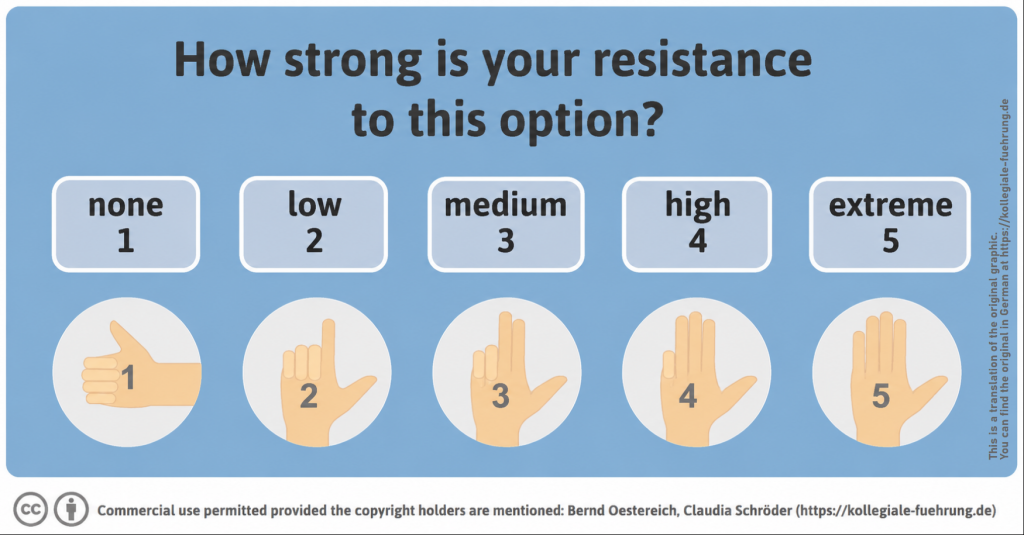
The illustration ‘Five hand signals’ shows the hand signals used to gauge resistance in the Universal Decision-Making Process. Using these, all participants simultaneously rate their level of resistance to various proposals on a scale of 1 to 5. The scores are added up, and the option with the lowest overall resistance is deemed the best solution. The status quo is also assessed as a separate alternative to ensure that no decision is made that would result in a deterioration of the situation.
Unlike the Consent procedure, the hand signals here do not represent different levels of objection, but solely the degree of personal resistance. They serve to facilitate a quick, numerically based selection between several options. There is no traditional veto threshold in this process. The procedure seeks the solution with the highest level of acceptance and does not necessarily aim for a decision free from vetoes. Only if this has been expressly agreed in advance can a high level of resistance be considered an exclusion criterion for a proposal.
Source: See here