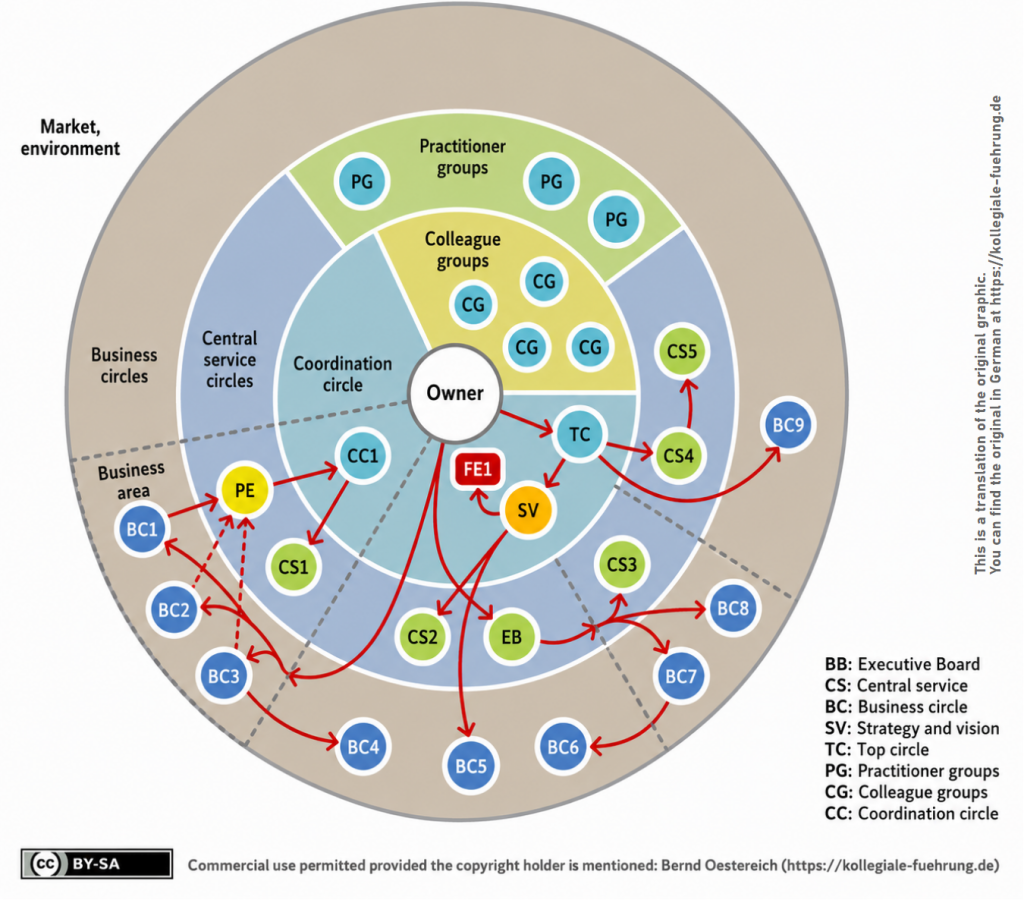
In contrast to traditional top-down planning, new circles emerge in a self-managed organisation when they are actually needed. The structure develops gradually from the demands of day-to-day work.
Who sets up new circles? #
New circles can be initiated by existing circles, committed teams or individual employees. Cross-functional or strategic circles are created by the Top Circle or – particularly in the initial phase – by the Owner and Strategy Circle.
When are new circles formed? #
There are three typical triggers:
• Refocusing: Support functions are spun off as a separate service circle.
• Cell division: A circle becomes too large or too complex and splits into smaller units.
• Innovation: New ideas or market opportunities lead to the establishment of new business or innovation circles.
Who bears responsibility? #
Each circle has a constituent parent circle that established it and can also dissolve it if necessary. Within its area of responsibility, however, the circle operates in a fully self-organised manner and bears technical, economic and social responsibility. Elected representatives link the circles together and ensure the flow of information.
How is unnecessary structural expansion avoided? #
The guiding principle is: as few circles as possible, as many as necessary. New circles are only formed where there is a genuine need and must demonstrate their long-term value. Regular reviews, financial transparency and the parent circle’s right to dissolve them prevent unnecessary expansion of the organisation.
Source: See here