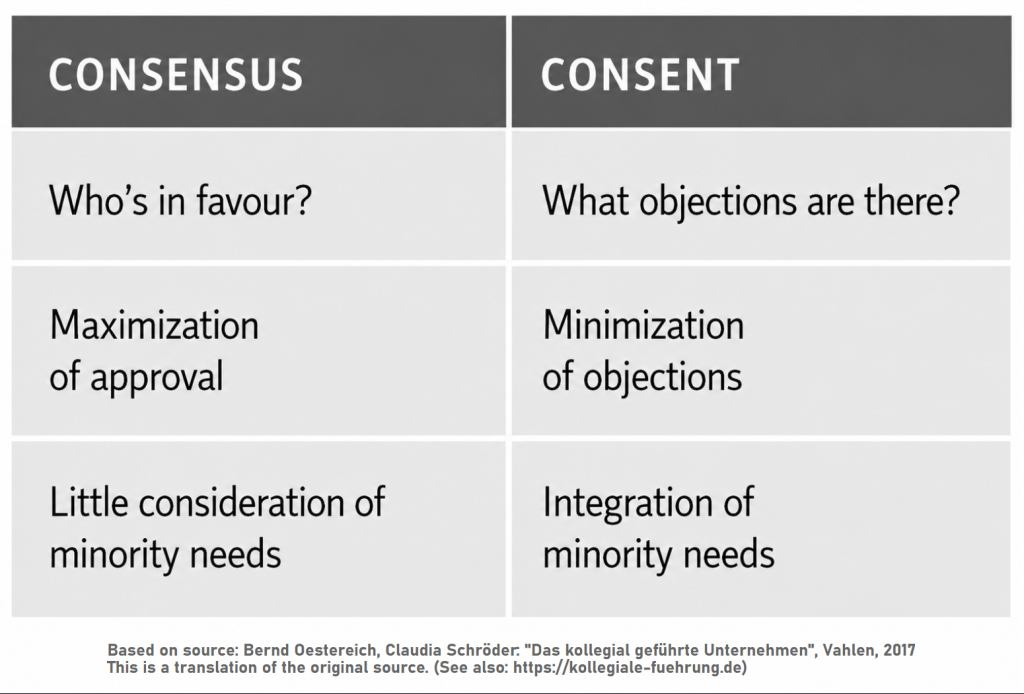
The diagram ‘Important differences between consensus and consent’ illustrates the fundamental difference between consensus and consent. Although the terms sound similar, they have different objectives.
Consensus and consent differ fundamentally in their approach. Whilst consensus focuses on the question of who agrees with a proposal, consent focuses on potential serious objections. The aim of consensus is to achieve as complete an agreement as possible, ideally unanimity. Consent, on the other hand, does not seek complete agreement, but rather a decision against which there are no justified objections and which can therefore be implemented with sufficient certainty.
For self-managed organisations, this difference is crucial. Consensus can delay decisions because it requires waiting for everyone’s agreement. Konsent, on the other hand, preserves the ability to act: what matters is not that everyone is enthusiastic, but that there are no objections that would undermine the common purpose. Another difference lies in the treatment of minority views. In konsent, objections are explicitly used to improve proposals, rather than being viewed as resistance. This often enhances the quality and acceptance of decisions.
The process is particularly suitable for decisions on principles and structure, as well as for smaller groups. However, it requires effective facilitation and a willingness to raise objections objectively and to work together to incorporate them.
Source: See here