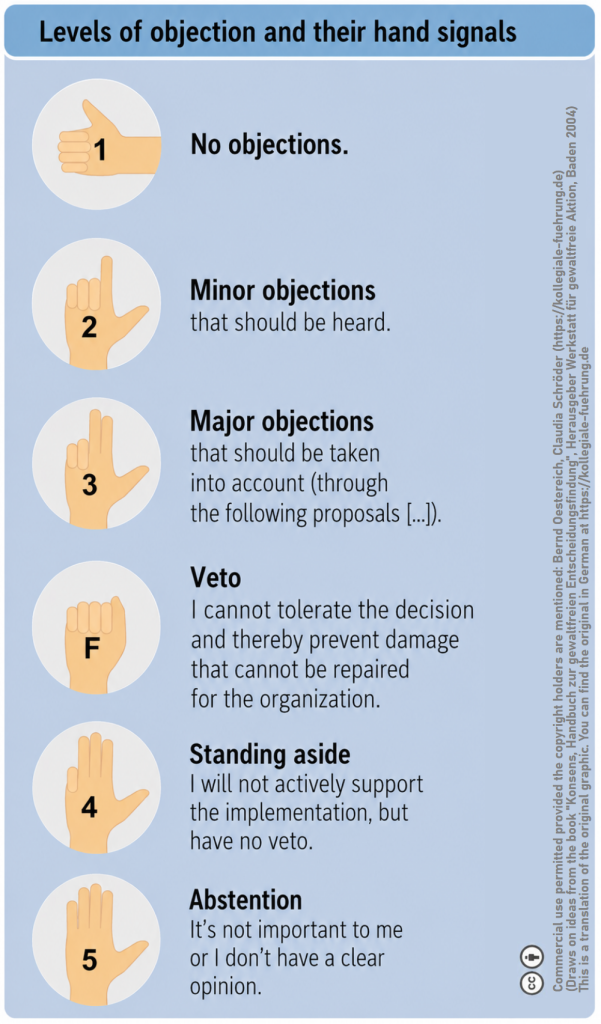
The diagram ‘Objection levels and their hand signals’ illustrates the qualitative levels of objection in the Konsent procedure. Each hand signal represents a specific stance on a proposal and has a clear significance for the subsequent decision-making process.
• 1 finger: full agreement.
• 2 fingers: minor reservations that should be taken into account.
• 3 fingers: serious reservations with a request for improvement; these are recorded in writing.
• 4 fingers: standing aside – no support, but no obstruction either.
• 5 fingers: abstention or trust in the group’s decision.
• Fist: veto – the emergency brake to protect the organisation. The objection must be justified and the person must contribute to finding a solution.
• ‘A’: Leaving the group – the last resort when no common ground can be found.
Unlike the ‘Five Hand Signals’, this method is not about calculating the path of least resistance, but about addressing the substance of objections. The consensus-building process is therefore particularly suitable for fundamental or complex decisions where all perspectives need to be carefully integrated.
Source: See here