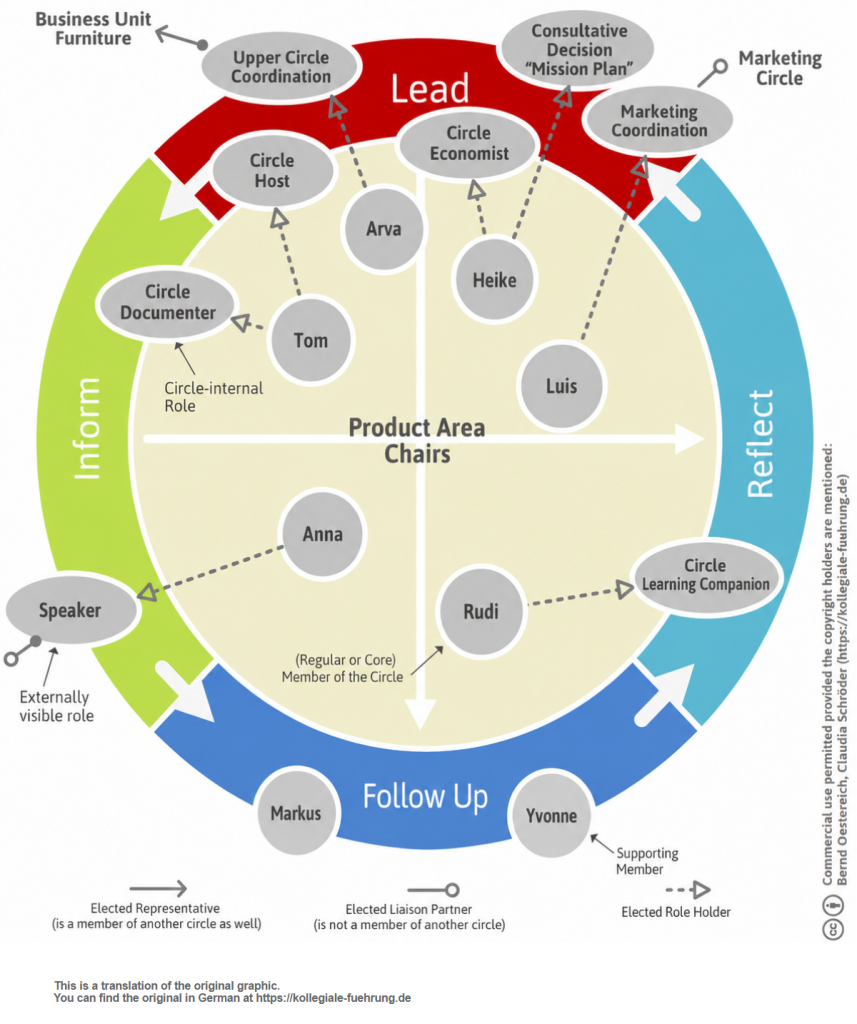
Using a specific example, this illustration demonstrates how a leadership circle operates in practice. Leadership is not entrusted to a single individual, but is distributed amongst various roles within the circle. Depending on the task at hand, core members take on different leadership and coordination roles – for example, within the circle itself or as a link to other circles. Supporters, on the other hand, focus on operational implementation and do not assume any leadership responsibility within this circle.
The four areas of leading, informing, following and reflecting are continuously intertwined. Decisions lead to implementation, information creates transparency, and reflection ensures that the circle learns from its experiences and continues to develop. The diagram makes it clear that, in a self-managed organisation, leadership is not a position but a shared responsibility: depending on the situation, each core member takes on the role of leader at one time and that of a contributor at another.
Basic structure of a circle: Roles #
A circle requires a minimum set of established processes and responsibilities in order to be able to manage itself systematically.
Typical basic roles (core members) #
The following roles form the ‘nucleus’ of self-organisation and should be established in every circle:
• Circle host: They bear organisational responsibility (not for content). They ensure that the circle is able to function, invite members to meetings, prepare agendas and ensure that all roles are filled.
• Circle Documenter: They are responsible for transparency. They keep the logbook, document decisions and keep the circle’s constitution up to date so that information is accessible to all.
• Circle Learning Guide: They organise retrospectives and reflection processes. Their aim is the continuous development of the circle’s collaboration and methods.
Additional situational roles #
Depending on needs and complexity, additional roles may be useful:
• Representative: Elected to represent the circle’s interests in higher- or lower-level circles. They have voting rights in both circles.
• Specialist Decision-Maker: Assumes ongoing responsibility for a specific specialist area (e.g. pricing or health and safety) to relieve the circle of operational burdens.
• Case Decision-Maker: Is temporarily authorised to make a single, complex decision, usually following a consultative process.
• Meeting Host (Facilitator): Is specifically responsible for facilitating and documenting the outcomes of individual meetings, to relieve the circle host of this burden.
• Contact Person: Acts purely as a point of contact for other circles or topics, without being a member of them.
• Observer: Ensures that agreed principles are adhered to during meetings, and that the group remains focused and treats one another with respect.
• Mentor: Supports new colleagues during their induction and integration into the circle’s culture.
Source: See here