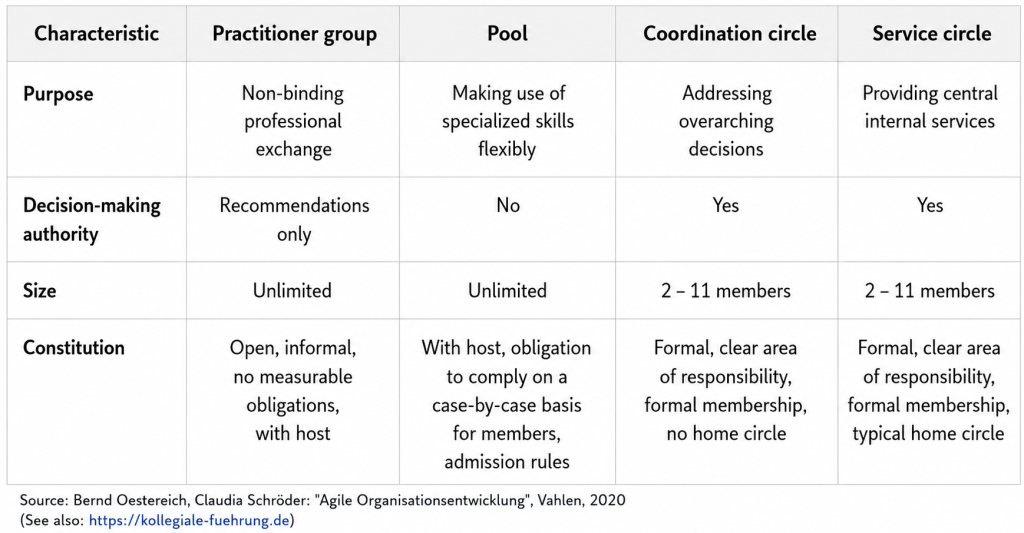
The overview of circle types categorises the various forms of collaboration within a self-managed organisation and highlights their different functions.
Business Circles form the periphery of the organisation. They generate direct value for external customers and make independent decisions on products, services and market-related issues. For many members, they are their primary home circle.
Central Service Circles support the Business Circles with specialised services such as IT, HR or finance. They operate according to the ‘Org-Shop’ principle: the value-adding units utilise their services as and when required.
Coordination Circles take on cross-functional tasks such as strategy, vision or shared direction. They often consist of representatives from various circles and are usually not a home circle in their own right.
Communities of Practice facilitate the exchange of experience and the professional development of specialists. They bear no business responsibility of their own and do not make binding organisational decisions.
Pools provide specific expertise in a flexible manner. They provide experts for temporary support services and are organised more simply than traditional circles.
Colleague groups provide a safe space for personal leadership, feedback and development. They operate confidentially and are not linked through formal organisational ties.
Together, these types of groups form a flexible network: business groups create value in the market, service groups support them, coordination groups connect the organisation, whilst communities of practice, pools and colleague groups facilitate learning, skills development and personal growth.
Source: See here