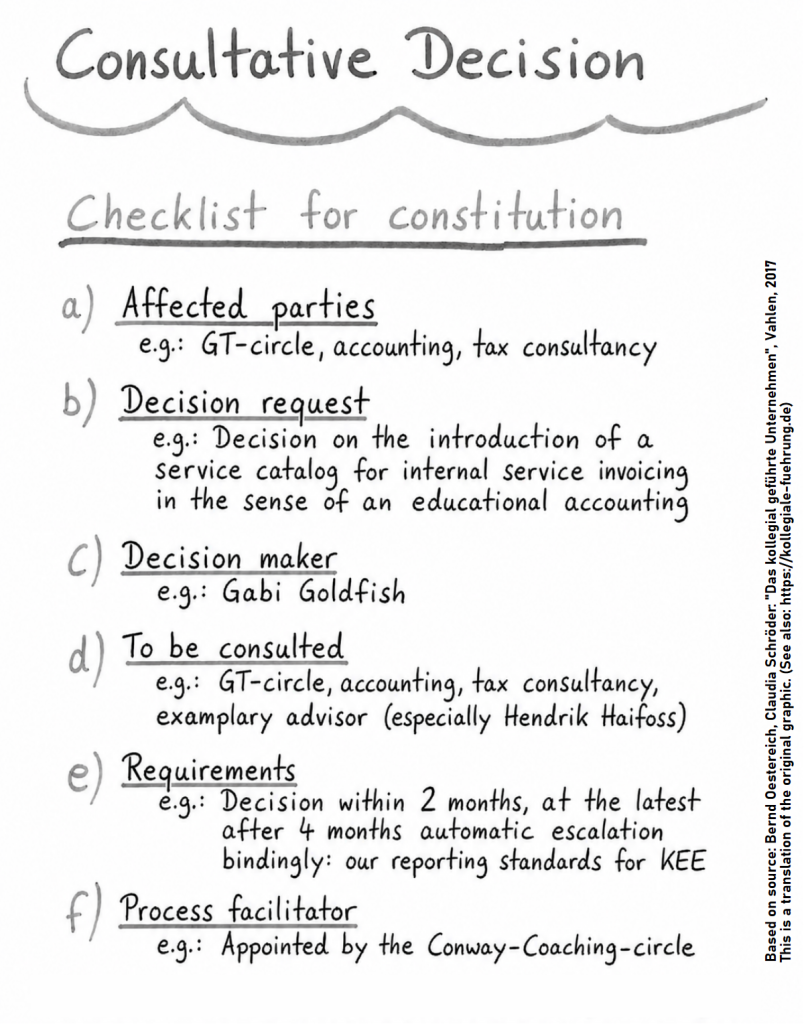
The figure ‘Checklist for the constitution of a consultative case decision’ serves as a structural template for defining the scope of a commissioned case decision. The checklist outlines the key points required for the first stage of a two-stage decision-making process. At this stage, the group reaches a consent-based decision on who should make the decision and under what conditions.
The six elements of the checklist ensure that the terms of reference are precisely defined #
a) Those affected: Who is affected by the decision?
b) Decision mandate: What exactly is to be decided?
c) Decision-maker: Which person (or team) will take responsibility?
d) Those to be consulted: Which experts or stakeholders must be consulted?
e) Constraints: What deadlines, budgets or framework conditions apply?
f) Process facilitator: Who provides methodological support to the decision-maker?
When should this method be used? #
Consultative case-by-case decision-making is appropriate in the following situations:
• Specialist knowledge: When a decision requires specialist knowledge that the group as a whole does not possess.
• High level of controversy: For issues where any outcome would provoke strong objections within the group, but a decision must nevertheless be made urgently.
• Efficiency: To avoid protracted group discussions by relying on the expertise of a single competent individual.
The individual process steps #
1. Identify the need: An initiator formulates the decision-making requirement using the checklist.
2. Clarification round: The group clarifies any questions regarding the task.
3. Forming opinions: Participants express their views on the elements of the checklist.
4. Joint solution development: The task, the decision-maker and the conditions are specified in detail.
5. Consensus round: The group officially authorises the decision-maker.
6. The actual decision-making process: The authorised representative consults stakeholders, develops solutions and selects the best option.
7. Conclusion & communication: The decision-maker announces the decision and explains the reasoning behind it.
What should be borne in mind to ensure good results? #
• Genuine consultation: The decision-maker must listen to the relevant individuals before making a decision, in order to truly incorporate their knowledge.
• Neutral process facilitation: A coach should support the decision-maker with communication and methodology, but must not intervene in the substance of the matter.
• Avoiding proportional representation: If a team rather than an individual is making the decision, it should be a ‘close-knit group’ and not a committee assembled solely for reasons of political fairness (representation of interests).
• Tolerance of error: The group must accept that the decision is valid and serves primarily the purpose of collective learning (‘forgiving the decision’).
• Principle of minimalism: When assigning a task, only those conditions should be defined that are truly necessary for proper authorisation.
Source: See here