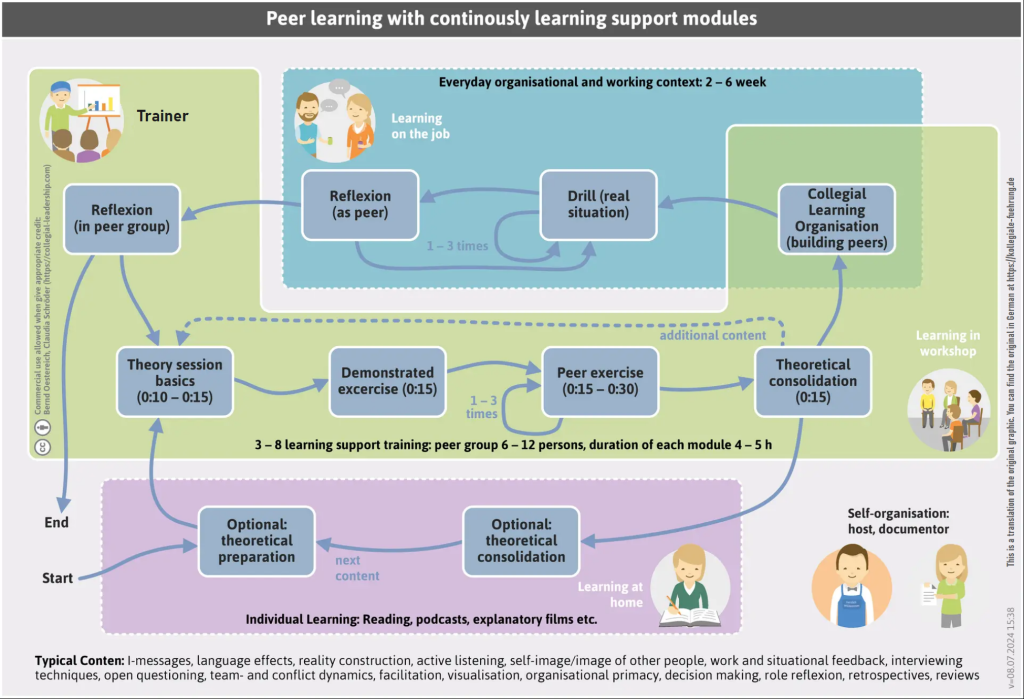
The diagram ‘Self-managed learning’ illustrates the overall framework of continuous learning support. The diagram depicts an integrated learning cycle that inseparably links the acquisition of knowledge (theory) with the development of skills (practice). The key interrelationships are:
• Interconnection of learning levels: The model links individual self-study, supervised group workshops and direct application in the workplace to form a coherent learning framework.
• Theory-to-practice transfer: Alternating between theoretical input and practical exercises prevents knowledge from remaining unused as ‘inert mass’.
• Peer-led self-management: Following the initial input from a trainer, learners take responsibility for their own progress in pairs or small groups.
The method is particularly suitable in the following situations #
• Cultural shift towards self-organisation: When fundamentally new approaches (e.g. a feedback culture, facilitation, consensus-building) are to be embedded within the organisation.
• Replacing old patterns of thinking: To replace deeply ingrained hierarchical behaviours with self-managed ways of working.
• Ensuring sustainability: When conventional seminars fail because everyday life immediately overshadows what has been learnt.
The individual process steps in detail #
The overall process is based on the cyclical structure of preparation, workshop and transfer:
1. Individual theoretical preparation (optional): Before the group meets, participants work through the basics independently. This is done by reading texts, listening to podcasts or watching educational videos. The aim is to use face-to-face time for exercises and reflection rather than for purely lecture-based teaching.
2. Face-to-face modules (learning groups with a trainer): In cycles (usually 3 to 8 modules), a fixed group (6–12 people) meets with a trainer. A module follows this structure:
o Theoretical basics: Short knowledge snippets lasting approx. 10–15 minutes (‘theory snippets’).
o Demonstrated exercise: The trainer or a mentor demonstrates how to apply the method.
o Dry run: Participants carry out role-plays or simulations in a safe space (approx. 15–30 mins).
o Theoretical consolidation & reflection: Clarification of questions and discussion within the group about the experience.
o Peer-led learning organisation: Participants form learning pairs and agree on specific homework tasks for their everyday working lives.
3. On-the-job learning (everyday work context): The actual learning takes place between the face-to-face modules (approx. 2–6 weeks):
o Practical exercise (real-life situation): A participant applies what they have learnt in a real work situation (e.g. facilitating a team).
o Observation: A learning partner observes the practitioner closely and gathers impressions.
o Reflection within the learning pair: Immediately after the exercise, both participants discuss their experiences. The observer provides feedback, and questions regarding integration into everyday working life are clarified.
4. Preparation for the next module: The experiences gained and any unresolved questions are collected so that they can be incorporated as material into the next workshop.
Points to bear in mind #
• Real-world challenges: Practice should be based on real tasks, as this makes the benefits immediately apparent.
• Explicit time buffers: The organisation must recognise learning as part of regular working hours and create the necessary space for it.
• Low-threshold start: Participants should not take on too much. Small, regular practice sessions are more effective than large, infrequent blocks.
• Flat hierarchy: All participants, regardless of their position, learn together as equals and give each other feedback.
• Error-friendly atmosphere: A trusting environment is needed in which experimentation and failure are recognised as a necessary part of learning.
Source: See here