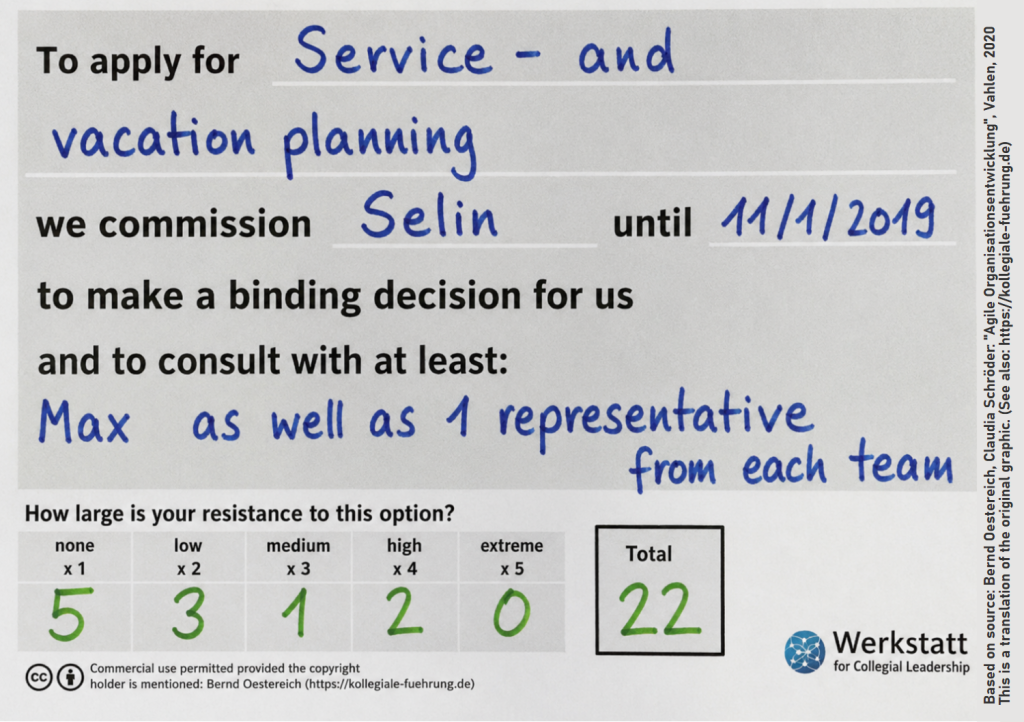
The diagram forms part of the Universal Decision-Making Process. The diagram illustrates the tabular analysis of a vote in which diverse proposed solutions compete against one another simultaneously. The key relationships are:
• Simultaneous evaluation: Instead of deciding on procedures, individuals and content one after the other, these are listed as alternatives of equal standing (e.g. a substantive proposal versus appointing a case decision-maker).
• Resistance measurement: Participants assign resistance values ranging from 1 (no resistance) to 5 (extreme resistance).
• Alternative 0: The current situation (‘Everything stays as it is’) is always included as a reference value to ensure that no decision is made that would result in a deterioration.
• Decision criterion: The total resistance points per row are added up. The option with the lowest total value is deemed to have been accepted.
When should this method be used? #
This universal method is particularly appropriate in the following cases:
• Need for efficiency: When ‘decision chains’ (first procedure, then decision-maker, then content) need to be avoided in order to save time.
• Lead-Monitor work: It is the standard procedure for facilitation at team or company board level.
• Complex situations: When it is unclear whether the group wishes to decide for itself or whether the matter would be better delegated to an expert.
• Limited alternatives: In practice, up to five proposals can be dealt with efficiently in a single round.
The individual process steps #
The procedure is strictly facilitated and comprises six core steps:
1. Appointing the facilitator: A moderator and an assistant to count the show of hands are appointed.
2. Collecting proposals: All alternatives (including Alternative 0) are collected. For each new option, it must be clarified who will implement it and who will organise the retrospective.
3. Presenting proposals: The moderator reads out the proposals. Any questions regarding understanding are clarified bilaterally between the questioner and the proposer; discussions or the expression of opinions are not permitted.
4. Measuring resistance: All participants raise their hands simultaneously (1–5 fingers). The totals are recorded for each alternative. Non-responses count as 1.
5. Determining acceptance: The group is asked whether there are any serious procedural flaws. If so, the person raising the objection must propose a remedy, which is then put to a vote again.
6. Determining the result: The option with the lowest level of resistance is read out aloud as the decision and documented.
What to bear in mind to achieve good results #
• Incorporating vetoes: As the procedure is primarily quantitative, veto options (e.g. ‘If there are two or more votes of 5, the proposal is considered rejected’) must be explicitly incorporated into the text of the proposal.
• Use of forms: To ensure that all necessary information (responsibility, retrospective) is available, structured templates should be used.
• Filtering in case of overload: If there are more than five alternatives, these should be reduced in advance through simple prioritisation (e.g. scoring).
• Disciplined clarification: The moderator must take great care to ensure that the presentation round does not degenerate into a debate on the substance of the matter.
In summary, the procedure offers a highly flexible and time-efficient way of making collective acceptance of different solutions quickly measurable and thus decidable.
Source: See here