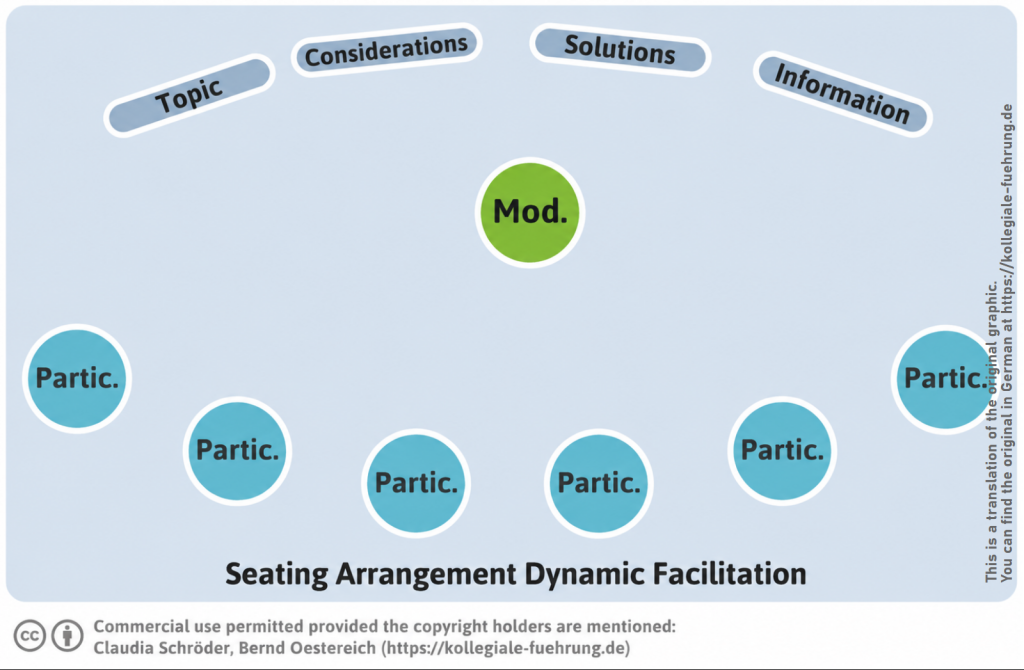
The diagram ‘Seating arrangement for Dynamic Facilitation’ illustrates the specific spatial configuration that is essential for the success of this in-depth facilitation method.
The significance of the seating arrangement #
The diagram illustrates a setting that differs fundamentally from conventional discussion groups:
• Focus on moderation: Participants sit in a semicircle or three-quarter circle and face the moderator and the four flipcharts/pinboards, not their neighbours.
• Avoiding confrontation: This arrangement prevents direct exchanges of words and side conversations between participants.
• Bilateral flow of communication: Every word is directed primarily at the moderator. The moderator acts as a buffer against emotional outbursts and tensions, creating a safer space for discussing difficult topics.
• Shared mental space: As everyone is looking at the visual aids, attention is directed away from personal sensitivities and towards collective problem-solving.
The Dynamic Facilitation (DF) process #
The process does not follow a rigid structure, but adapts to the group’s erratic, associative thinking:
1. Purging: Participants first ‘empty’ themselves by speaking, in order to free themselves from the abundance of thoughts, masks and feelings they have brought with them.
2. Associative Thinking & In-Depth Listening: Through appreciative, deep listening, associative streams of thought are stimulated that go beyond rational problem-solving.
3. Breakthrough: The process is guided until the ‘wisdom of the group’ produces a solution that is supported by everyone.
4. Storytelling: In the case of a ‘decision-making council’, the outcome is then communicated to the organisation through storytelling.
What to bear in mind to achieve good results #
For Dynamic Facilitation to realise its full potential, the following conditions must be met:
• Time without pressure: The method requires plenty of time and a space where the pace is slowed down; time pressure prevents people from speaking ‘from the depths’.
• Facilitator’s approach: The moderator must be ‘empty’, act without preconceptions and be able to hold the space for tensions.
• Four visualisation categories: Contributions must be consistently sorted into the fields 1) Topic/challenge, 2) Concerns/fears, 3) Solutions/ideas and 4) Perspectives/information.
• Strict rules: Participants speak only to the moderator, do not interrupt one another and practise ‘in-depth listening’ (full focus on the person they are speaking to).
• Appropriate choice of topic: The method should be reserved for seemingly intractable, deadlocked or highly contentious issues. In summary, the diagram illustrates a psychologically grounded spatial concept which, by disrupting habitual patterns of interaction, paves the way for genuine innovation and consensus in complex situations.
Source: See here