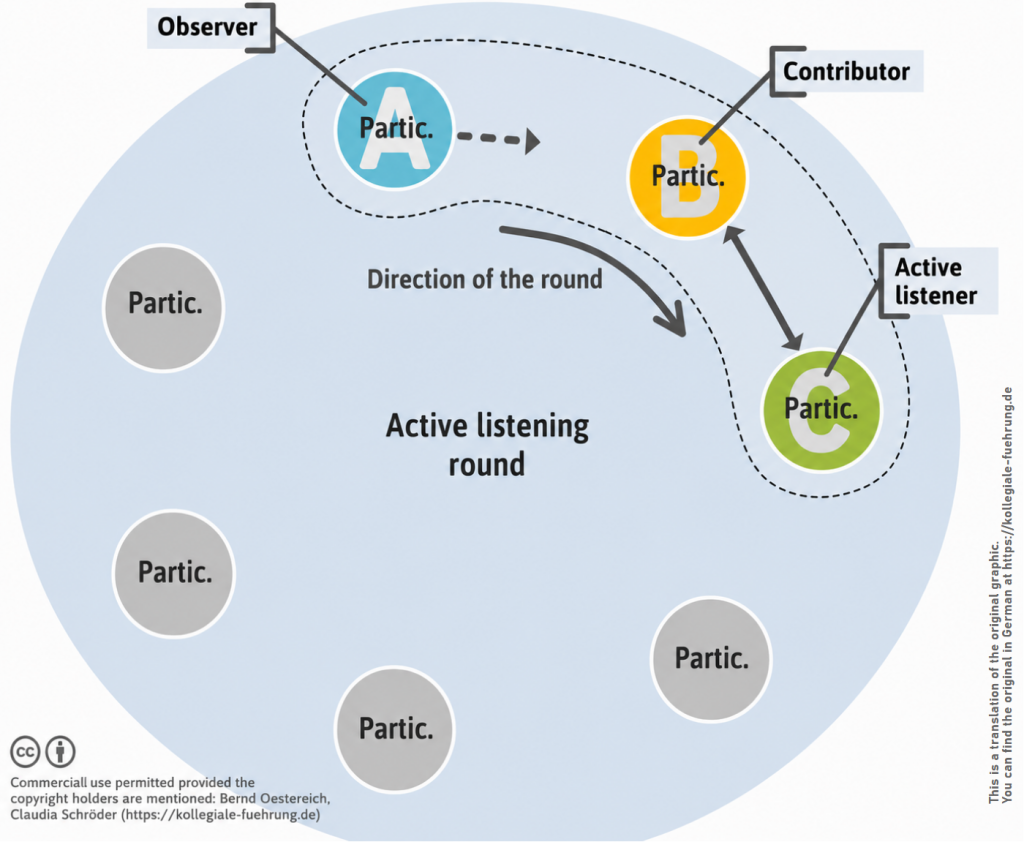
The diagram ‘Active listening group’ describes a highly structured discussion format for small groups. It is designed to foster a deeper understanding of individual perspectives, opinions or ideas without immediately judging them. The diagram illustrates the dynamics within a small-group setting (3–5 people), in which, despite the group context, a focused interaction between three people is always at the centre:
• Role allocation: Within the group, three neighbouring people are always active: a speaker (B), a listener (C) and a facilitator/observer (A).
• Flow of communication: The conversation takes place bilaterally between B and C, whilst the remaining group members listen attentively and in silence.
• Rotation: The roles rotate clockwise (or anti-clockwise) around the circle, so that each member takes on each function in turn.
The individual steps of the process #
1. Preparation: The whole group is divided into small teams of 3–5 people.
2. Setting the framework: The group agrees on the duration, the number of rounds and the time allocated per contribution (often 30–60 seconds for speaking and active listening).
3. Making a contribution: Person B addresses their contribution directly to Person C.
4. Active listening: Person C repeats what they have heard in their own words, showing appreciation.
5. Confirmation: Person B checks whether they have been understood correctly and, if necessary, corrects or adds to their contribution until Person C can repeat what they have understood correctly.
6. Monitoring: Person A ensures that the principles of the discussion (sticking to time limits, maintaining focus) are upheld.
7. Rotation: The roles rotate until every participant has had a turn.
What to look out for to ensure good results #
To ensure a high-quality discussion, the following principles must be strictly adhered to:
• Strict discipline: The facilitator (A) must intervene consistently if time limits are significantly exceeded.
• Focus on a single aspect: Only one contribution (an idea, a question or an objection) may be made per person per round.
• Observers’ duty of silence: Anyone not currently in roles B or C must not speak and must listen attentively.
• Avoiding repetition: To maintain efficiency, only new points should be raised; what has already been said must not be repeated.
• Use of ‘I’ statements: The contributor speaks only for themselves, without evaluating the contributions of others. • Appreciative attitude: When Person C repeats a point, they must do so with an appreciative attitude in order to open up the ‘black box’ of individual perception to some extent.
Source: See here