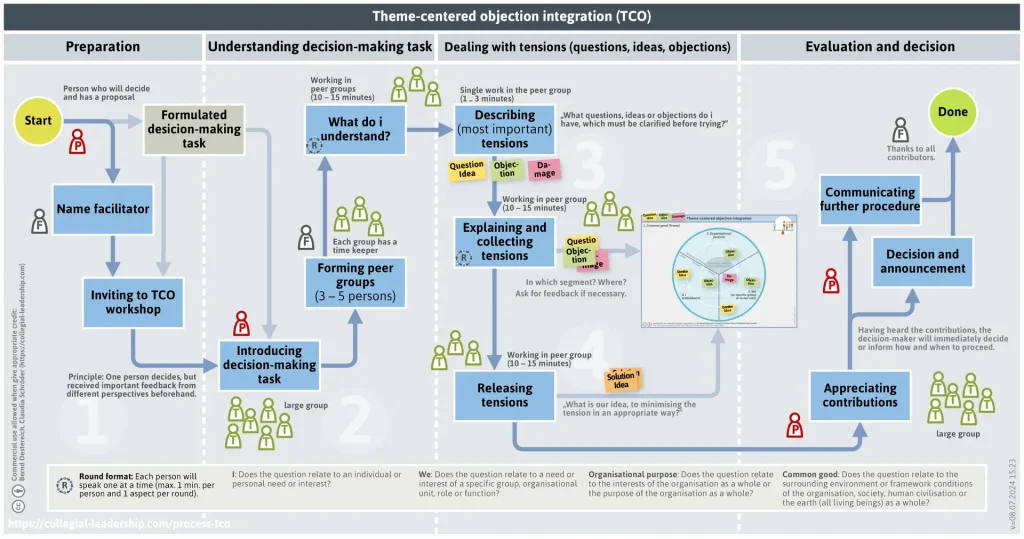
The diagram ‘Theme-centred objection integration process’ illustrates a key tool for theme-centred objection integration.
The diagram describes a workshop format for involving a large group (from 15 to 250 people) in a complex decision-making process. It is a synthesis of the Consent principle (freedom to veto) and Ruth Cohn’s four-factor model (Theme-Centred Interaction).
The key concepts are #
• Multi-perspective categorisation: Objections are not merely regarded as ‘against’, but are assigned to the segments ‘I’ (individual), ‘We’ (group), ‘organisational purpose’ (‘It’) and ‘common good’ (‘Globe’).
• Color logic for severity measurement: Yellow stands for questions/ideas, green for minor concerns and pink/red for serious objections (risk of unmanageable damage),.
• Prioritisation through positioning: Contributions are pinned in such a way that serious objections are placed close to the centre (the proposed decision), whilst minor comments are placed on the periphery.
The process is highly structured and follows a logical sequence #
1. Preparation & presentation: A specific, written proposal is presented. The proposer (usually the management) must be prepared to further develop the content of the draft or even abandon it.
2. Forming small groups & understanding: Participants work in groups of 3 to 5 people to clarify: ‘What have I understood?’. This is often achieved through active listening within the group.
3. Identifying objections: The groups develop questions, ideas or objections that absolutely must be clarified before any trial takes place.
4. Collection & classification: Contributions are filtered by urgency: only those that could cause unacceptable harm to the organisation are classified as serious objections (pink/red) and placed on the noticeboard.
5. Integration: Small groups develop solutions, particularly to minimise the serious objections to such an extent that the proposal becomes ‘safe enough to try out’.
6. Evaluation & Decision: The proposer reviews the contributions, thanks everyone for their input and decides on the next steps (adjustment, withdrawal or implementation despite remaining concerns).
Points to bear in mind #
• Openness to different outcomes: The process fails if the proposal is already set in stone and the integration stage serves only to legitimise it.
• Priority of the organisation: Objections must be justified and, ideally, relate to potential harm to the organisation, not purely self-serving interests.
• Obligation to contribute: Anyone raising an objection must actively work to resolve it by suggesting improvements.
• Strict facilitation: To avoid endless discussions in large groups, adherence to the ‘round-robin’ principle (everyone speaks in turn without interruption) is essential. • Focus on ‘safe enough to try’: The aim is not the perfect solution, but the elimination of existential risks in order to move quickly into an empirical testing phase.
Source: See here