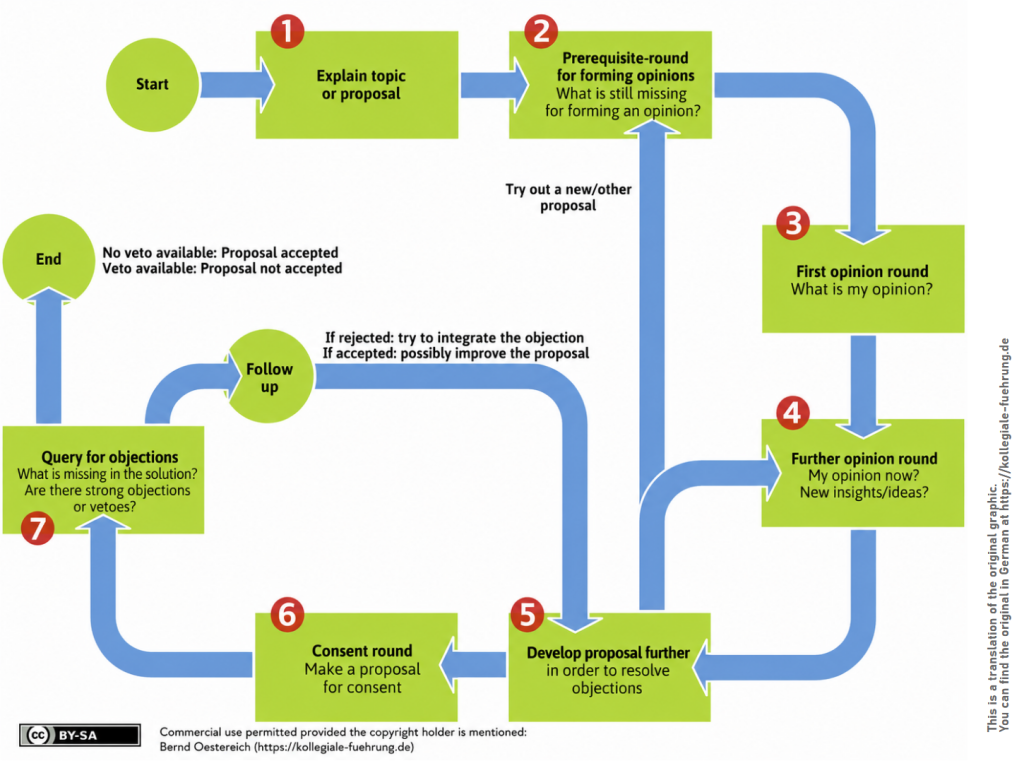
The diagram ‘Objection Integration Moderation’ illustrates a highly structured facilitation format for collaborative decision-making. It visualises a phase-based process that aims not at maximum agreement (consensus), but at the absence of resistance (consent).
The process follows a logical sequence of steps to refine a proposal to the point where it is ‘safe enough to try out’ #
a) Information round: The proposal is presented and any questions regarding understanding are clarified bilaterally, with no opinions being expressed at this stage.
b) Opinion round: All participants take turns to express their views and feelings regarding the proposal, without entering into a discussion.
c) Feedback round: The group discusses the views expressed to identify new insights or changed perspectives.
d) Organisational priority: The facilitator makes it clear that individual interests are subordinate to the interests of the organisation and that only serious harm justifies a veto.
e) Formulation of the proposal: The initiator adapts the proposal based on the feedback in such a way as to minimise objections; the result is set out in writing.
f) Decision: Participants are explicitly asked whether they have any serious objections; if no veto is raised, the proposal is deemed to have been accepted.
To ensure high-quality decisions and acceptance, the following aspects should be observed #
• Strict moderation: The procedure requires consistent leadership that curbs discussions and keeps the focus on the flow of the process.
• Round-table principle: Strictly speaking in turn (the round-table principle) ensures that everyone is heard and prevents emotional exchanges.
• Obligation on those raising objections: Anyone who has an objection is obliged to contribute to finding a solution and to put forward suggestions for improvement.
• Definition of a veto: A veto must not be a matter of personal preference, but must avert damage that threatens the organisation’s very existence.
• Thorough preparation: Complex topics must be provided to participants in writing at an early stage to enable them to form well-informed opinions.
• Separation of roles: The facilitator should remain neutral on the substance of the matter; if they are personally involved, this change of role must be made transparent.
Dealing with disruptions #
If deeper conflicts arise, the process should be suspended and the issue referred to a separate conflict resolution procedure.
Source: See here