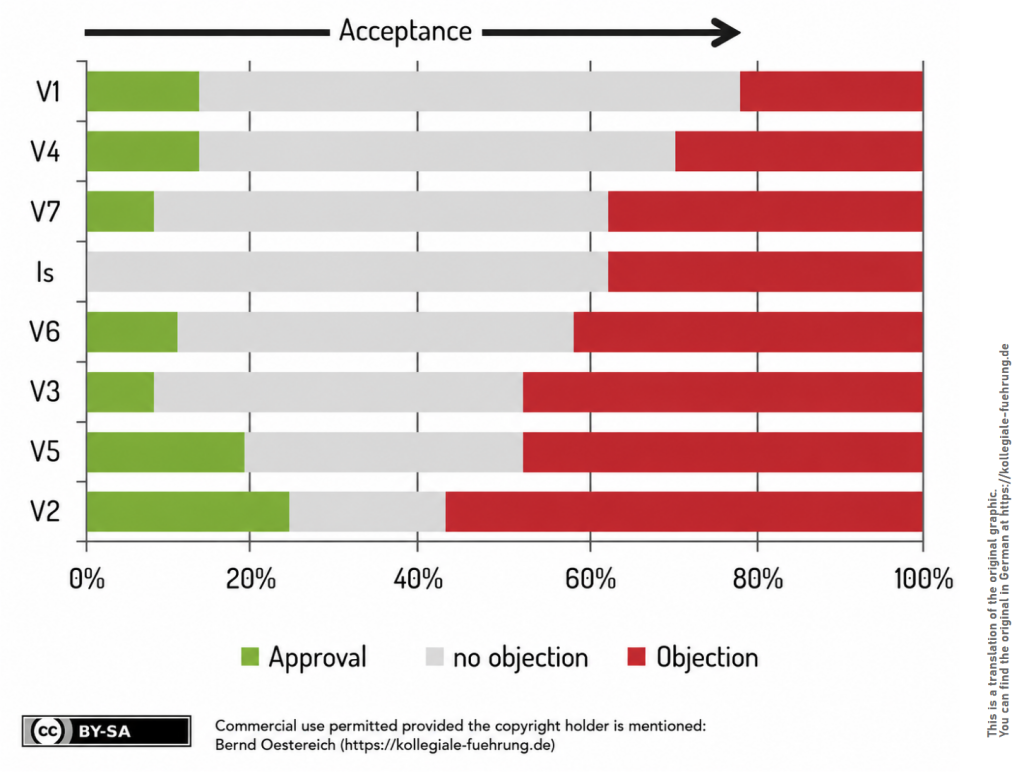
The diagram ‘Agreement vs. Resistance Query’ illustrates the difference between a traditional agreement query and a resistance query (systemic consensus-building). Whilst an agreement query seeks the most popular solution, the resistance query identifies the proposal with the highest level of acceptance – that is, the least resistance. In the example shown, proposals V2 and V5 do indeed receive the most agreement, but at the same time provoke the strongest resistance. Conversely, V1 and V4 show the highest level of acceptance and even represent an improvement on the current situation (IS). The diagram thus makes it clear that high levels of agreement do not automatically lead to high levels of acceptance. For self-managed organisations, the resistance survey is therefore often the more suitable method, as it promotes viable decisions and reduces polarisation.
Source: See here