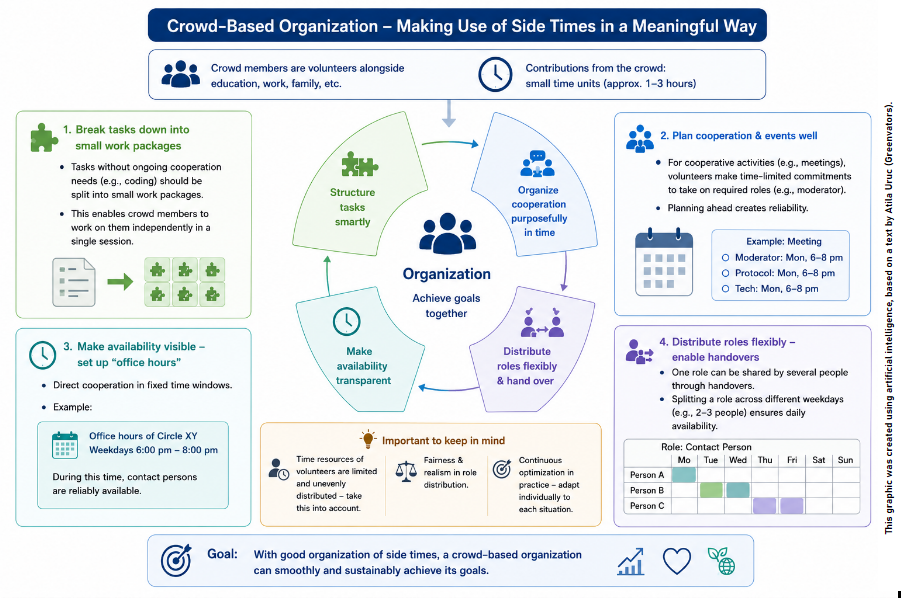
When an organisation operates on a crowd-based model, the individual contributions of crowd members are usually divided into smaller time units (of around 1–3 hours). This is because volunteers also have a main external activity (education, work, etc.) alongside their crowd membership, to which they devote the majority of their working time. The art of a crowd-based organisation lies in organising these ‘spare moments’ in such a way that the organisation can achieve its goals as smoothly as possible. Tasks that do not require ongoing collaboration – such as, in some cases, writing code – should, where possible, be broken down into smaller work packages so that crowd members can complete these tasks independently in a single session. For events that involve collaboration, such as organising meetings, some of the participating volunteers must commit to taking on necessary roles (e.g. moderator) for a limited period of time.
When crowd members take on individual group roles, it should be borne in mind that even committed crowd members have only a limited and potentially unevenly distributed amount of time available. Perhaps this problem could be addressed by setting up ‘office hours’ during which direct collaboration is possible, for example: ‘Office hours for Group XY on weekdays from 6 pm to 8 pm’. There is also the option of dividing a role amongst several volunteers in the sense of a ‘handover’. Accordingly, the responsibilities of a specific role could be shared amongst around 2–3 volunteers across different weekdays, ensuring that a point of contact is still available every day. These are just a few ideas to serve as a starting point; they will need to be further refined in practice and tailored to each individual situation.