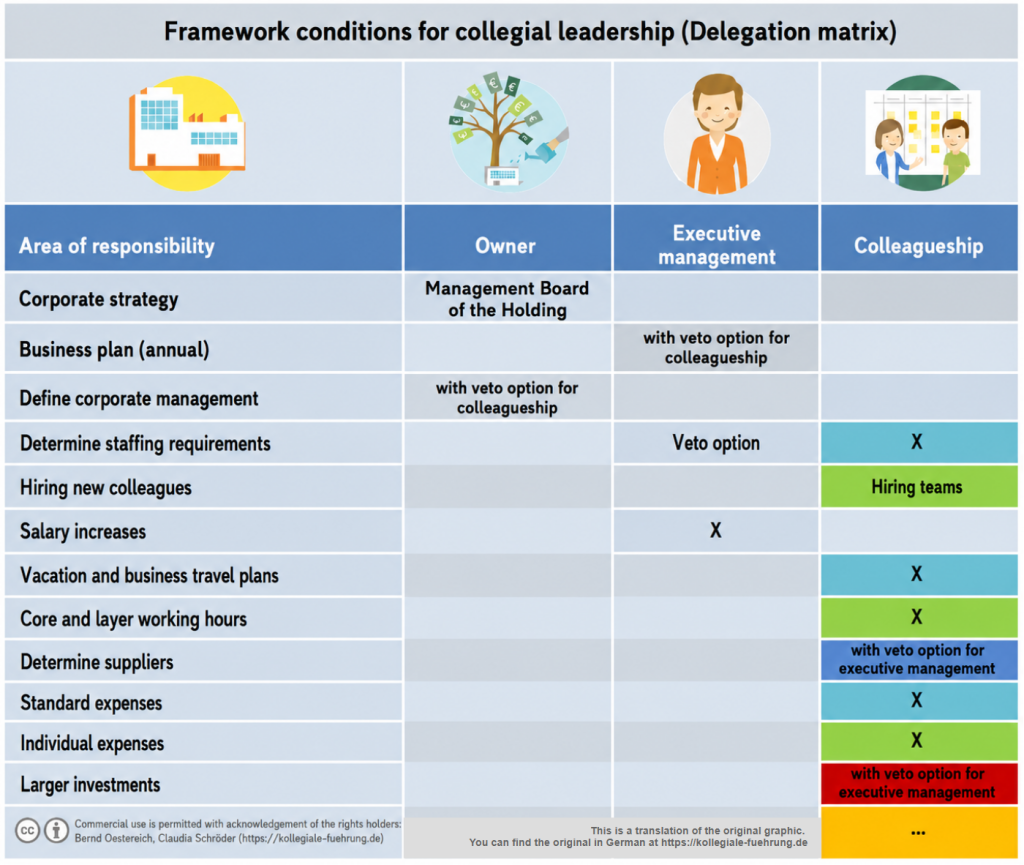
The ‘Delegation Matrix’ is a key tool for clarifying responsibilities and decision-making powers within a self-managed organisation. Together with the circle model and the circle constitutions, it forms the formal basis for self-organisation. The matrix assigns areas of responsibility to the relevant bodies – for example, owners, management or groups of colleagues. This clearly defines who is authorised to make decisions, shape processes and assume responsibility. At the same time, the matrix provides transparency regarding remaining framework conditions and potential veto rights, which serve to strike a balance between self-organisation and corporate responsibility.
Colour-coding enhances the clarity of the delegation matrix and makes the maturity level of responsibility-taking apparent at a glance. Red indicates areas of responsibility that still lie with management but may be taken over by colleagues in future. Blue marks areas that are in preparation for the transfer of responsibility. Green stands for responsibilities that have already been taken on on a trial basis or on a case-by-case basis, but whose viability has not yet been conclusively assessed. Turquoise indicates areas of responsibility that have been fully and permanently delegated to colleagues. In addition, notes or conditions (e.g. ‘salary transparency to follow’ or ‘support from the finance group’) can provide further clarification of the respective delegation framework. The delegation matrix does not describe a final state. It evolves alongside the organisation and is adapted as soon as groups of colleagues take on new areas of responsibility. Its purpose is to provide clarity and certainty: every person involved knows which decisions can be made independently, where the boundaries lie and who is responsible for specific matters.
Source: See here