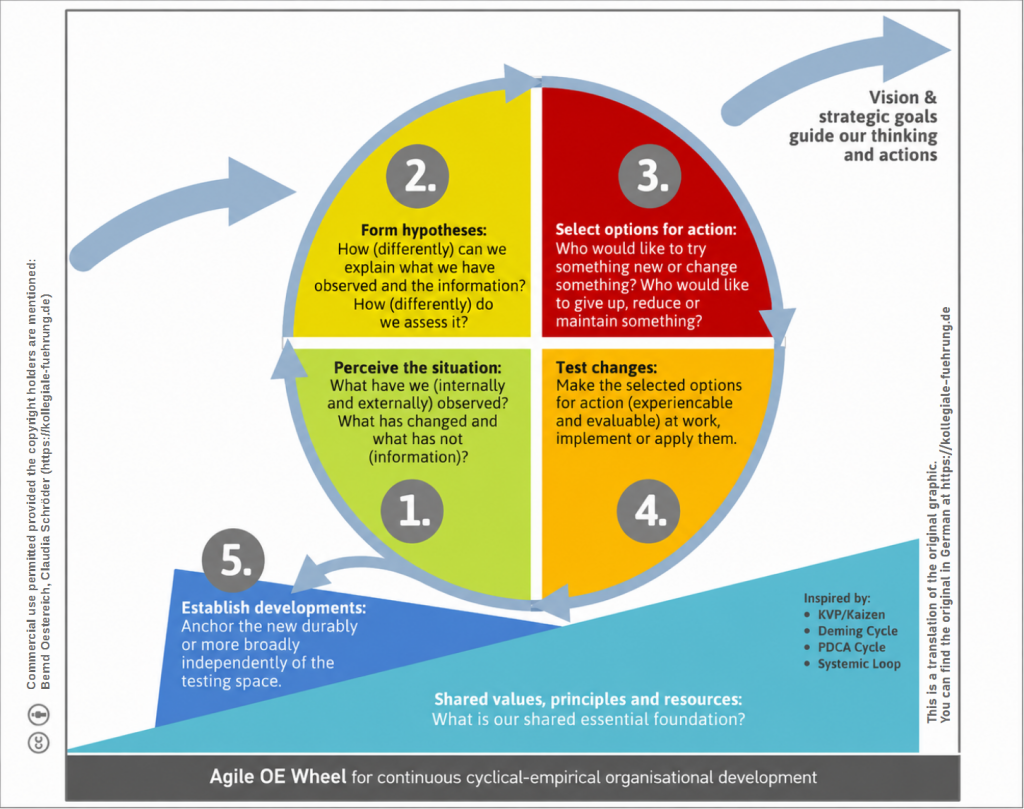
The ‘Agile Organisational Development Wheel’ describes a continuous learning and development process for organisations operating in complex environments. Rather than managing change through long-term master plans, the organisation evolves through experimentation, observation and adaptation.
The cycle consists of five steps #
1. Gain insights: The organisation gathers facts, observations and experiences in order to understand the current situation as objectively as possible.
2. Form hypotheses: Based on these insights, assumptions are developed about possible correlations and causes.
3. Invent options for action: On this basis, concrete ideas for change emerge, which are initially tested on a limited scale.
4. Test changes: The measures are implemented as experiments and evaluated on the basis of their actual impact.
5. Establish developments: Successful solutions are permanently integrated into processes, roles or structures. The entire process is guided by shared values and principles. The wedge shown in the diagram symbolises the necessary standardisation: successful changes are embedded so that the organisation does not revert to previous patterns. In practice, the Development Wheel is particularly well-suited to retrospectives. The first three steps create a shared understanding and new options, whilst implementation and embedding subsequently take place in day-to-day work. This creates a continuous cycle of learning, adapting and further developing.
Source: See here