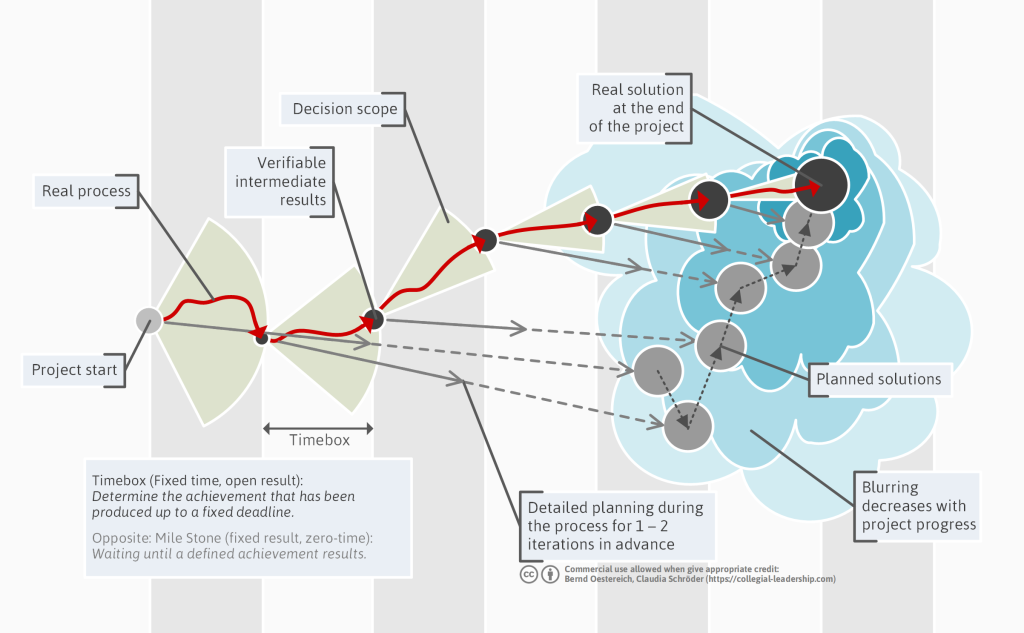
The ‘small-step trial and error approach’ model describes a methodology for complex and dynamic environments in which the exact path to the goal cannot be predicted. Rather than relying on detailed long-term planning, the organisation moves step by step through a zone of uncertainty. The actual path emerges adaptively: intermediate goals and insights gained from practice determine the next steps. As experience grows, uncertainty diminishes and the way forward becomes clearer.
Development takes place in short iterations with a limited time horizon. Through timeboxing, experiments are embedded within fixed timeframes to generate quickly verifiable results and learn from them. Unlike traditional projects, the focus is not on a predefined end result, but on the continuous acquisition of knowledge. Every step follows the principle of empirical learning: try it out, observe, evaluate and then decide whether an approach should be continued, adapted or discontinued. Small steps also limit the risk, as any potential missteps remain within the bounds of an ‘affordable loss’. The role of leadership changes as a result: rather than prescribing the path in detail, it creates the framework for safe experimentation, learning and autonomous adaptation.
Source: See here