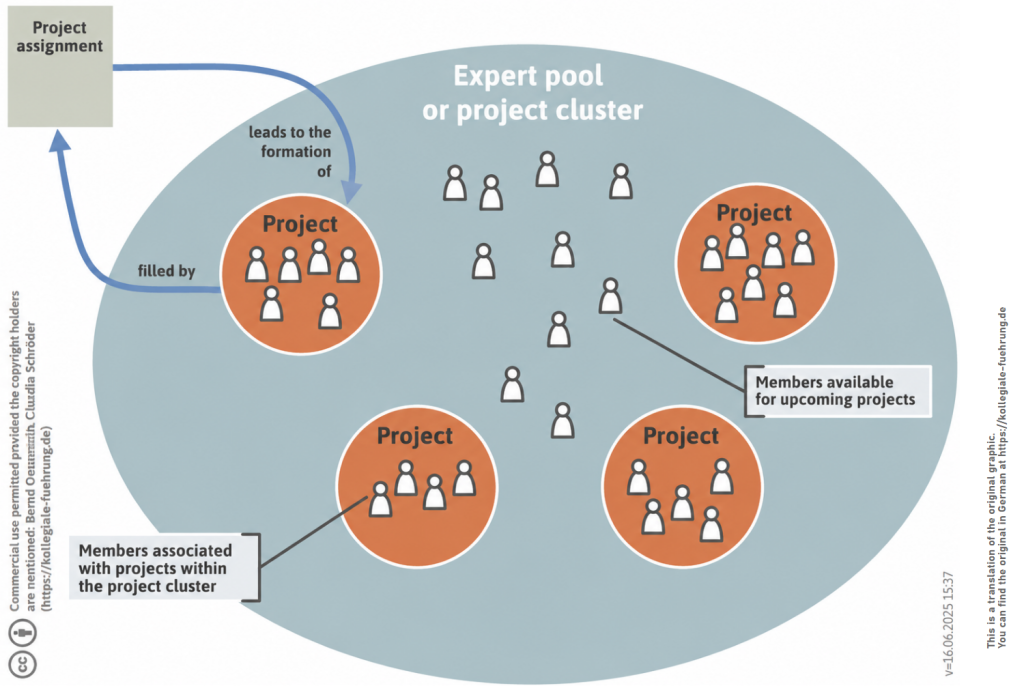
The Skilled Workforce Pool model describes a flexible way of making specialist knowledge available within a self-managed organisation. A pool brings together colleagues with specific skills who can be called upon on a temporary basis by other groups as and when required – for example, for facilitation, coaching or conflict resolution. This means that groups do not need to maintain rarely used skills in-house on a permanent basis.
Unlike a traditional circle, a pool is simply organised. It usually requires no extensive roles or regular meetings, but primarily coordinates the supply and demand for expertise. A role such as a pool supervisor can assist with this coordination.
Pools differ from communities of practice: whilst pools provide specific services to other circles, communities of practice serve primarily to facilitate exchange, learning and the development of skills. Individuals can be active in both structures simultaneously.
Typical examples include internal facilitator or transformation pools. Where there is a highly specialised need, external expert pools can also be established.
If the pool’s service is provided as a core task, the pool functions as a central service circle. Where support is provided to other circles on an occasional basis, internal cost-allocation models can help to manage capacity transparently.
Every member of the organisation belongs to a home circle (primary circle). This is where their primary affiliation lies, where they spend the majority of their working hours, and where their social ties are rooted. Participation in a pool complements this affiliation but does not replace it.
Source: See here